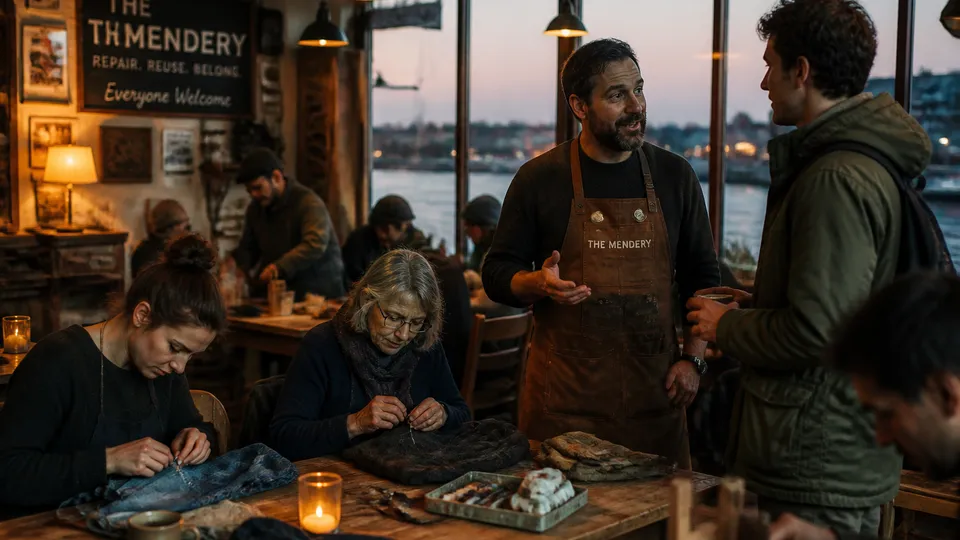
On a February morning when the wind off the Souris River cut through the front door, Willow & Main smelled of espresso and sawdust. Volunteers had pushed tables aside to make room for a workbench: tonight they would mend boots and patch coats bound for a coat drive. Heather McLellan, apron smeared with flour, moved through the room like a conductor.
Heather opened the café in 2013 with no plan to run a civic experiment. Born to a second-generation farming family east of Brandon, she came to town to study hospitality and stayed because she liked the way strangers greeted one another on Princess Avenue. The café was supposed to be a tidy, profitable local business. It became something else after a pair of decisions that look obvious now but were radical at the time: to invite the community in not just as customers but as collaborators, and to measure success in hours volunteered, meals shared, and houses made safer.
The model is practical rather than performative. Willow & Main runs what Heather calls 'service evenings' twice weekly. One night is kitchen-centered: surplus ingredients from local grocers are turned into soups and bakes by volunteers, who then package meals for homebound seniors and the Brandon Friendship Centre. The other is a 'makers' night—carpentry, sewing, and small appliance repair led by tradespeople who donate time. Heather slots the work to meet immediate needs. When the atrisk-housing block on the north end needed storm windows last spring, the café coordinated wood donations, volunteer carpenters, and a fundraising brunch that covered materials.
The numbers give an outline of the impact without flattening the stories. Since 2016, Willow & Main has logged more than 3,500 volunteer hours, distributed an estimated 15,000 meals through partner organizations, and organized 27 home repair days for seniors and low-income households. Those figures are important because they ground Heather's rhetoric in accountability; they also conceal the quieter outcomes that matter most to her—connections formed across generational and cultural boundaries.
'It started with a woman who came in every morning to warm up and never ordered anything,' Heather remembers. 'One winter day she stayed to help roll buns. Six months later she was teaching newcomers to knit.' That woman, Maria Lopez, had arrived in Brandon as a refugee in 2017 and struggled with isolation. Today she helps run the café's Stitch & Serve program, which repairs clothing and makes warm items for families in need. 'Willow gave me a place and a purpose,' she says. 'Now I bring others.'
Partnerships have been central. Heather forged ties with the Brandon Food Bank, the Friendship Centre, Prairie Mountain Health, and the Westman Youth Centre. Together they designed referral systems: social workers alert the café to households that could use warm meals or minor home repairs; the café mobilizes volunteers and logs the outcomes. Kenji Sato, director of the Brandon Volunteer Hub, calls the network Heather built 'a practical trust machine'—local people learn they can rely on one another through repeated small acts. 'It reduces the friction between need and help,' he says.
Not every chapter has been smooth. Heather has had to navigate the pressures of running a profit-making enterprise while sustaining a service mission. Staff turnover is higher than she expected; some employees chafe at the extra evening commitments. Funding for materials can spike—when a major plumbing issue hit one of the low-income housing units last year, the café's coffers were insufficient, and Heather spent days fundraising between shifts.
She manages those tensions with candid governance. Willow & Main publishes quarterly impact reports and convenes an advisory council of volunteers, nonprofit partners, and customers. The council helped pilot a small-membership scheme that channels a modest monthly fee into a 'rapid response' fund for urgent repairs. The idea is simple: distribute the cost of emergency assistance across a base of regular supporters so the café never has to turn its back on a household in crisis.
More than anything, Heather's work is about remaking civic muscle. In a region where services can be thin and professional volunteers are scarce, the café's approach trains ordinary citizens to act. Teenagers who once spent evenings scrolling through screens now learn the mechanics of a hammer and how to listen to an elder's story. Immigrants practice English while mending a sock. Tradespeople find a low-risk place to pass on skills.
Heather's forward-looking plans are modestly ambitious. She wants to pilot a mobile 'service kitchen' to reach rural hamlets in Westman, and to formalize a training curriculum for volunteer coordinators that other small businesses can adopt. She also talks about succession with the care of someone who knows how fragile social experiments are: a board ready to steward the mission rather than a single charismatic founder.
At the end of a long shift, Heather stands at the counter and tallies the day's work in a notebook. The café will always sell coffee—it's the economic engine—but the ledger beside the cash register records more: hours contributed, meals packed, windows repaired. The real accounting, she says, is the quiet reframing of what a business is permitted to be in a small city: not merely a place to buy a product but a place to practice civic life. 'Success,' Heather tells me, 'isn't just the bottom line. It's that someone feels they belong enough to show up.'