On a cold March evening, the gallery on Princess Avenue was full: seniors in wool coats, students with paint-splattered sleeves, parents whose children had once shown art at the school fair. The Art Gallery of Southwestern Manitoba had opened a show that paired archival photographs of early prairie life with new work by Indigenous and immigrant artists. Conversations moved from technique to lineage to stubborn questions about belonging. For many in Brandon, the room felt like the city condensed — a place where memory and imagination negotiate what the region will become.
Brandon's cultural life did not arrive fully formed. It accreted, as communities do, around institutions and kitchen tables. Rail lines, settler migration, and agricultural fairs gave the town its initial public stages; churches and fraternal halls provided the earliest theatres and concert spaces. But equally important were informal networks: potluck recitals, Ukrainian dance parties, Mennonite quilting bees, and empty factory floors repurposed for rehearsals. Over the 20th century, those strands braided into a civic culture that has survived boom-and-bust economies by insisting on art as both solace and civic work.
Two institutions anchor that story today. Brandon University, with its School of Music, functions as a civic conservatory — training musicians who teach in classrooms across Westman, enlivening local festivals and forming ensembles that make touring possible without leaving the region. Meanwhile, the Art Gallery of Southwestern Manitoba, established as a community gallery decades ago, has become a shore where emerging voices land beside historical collections. The Royal Manitoba Winter Fair and the Keystone Centre, meanwhile, remain places where the province's agricultural rhythms intersect with concerts, craft shows, and community gatherings.
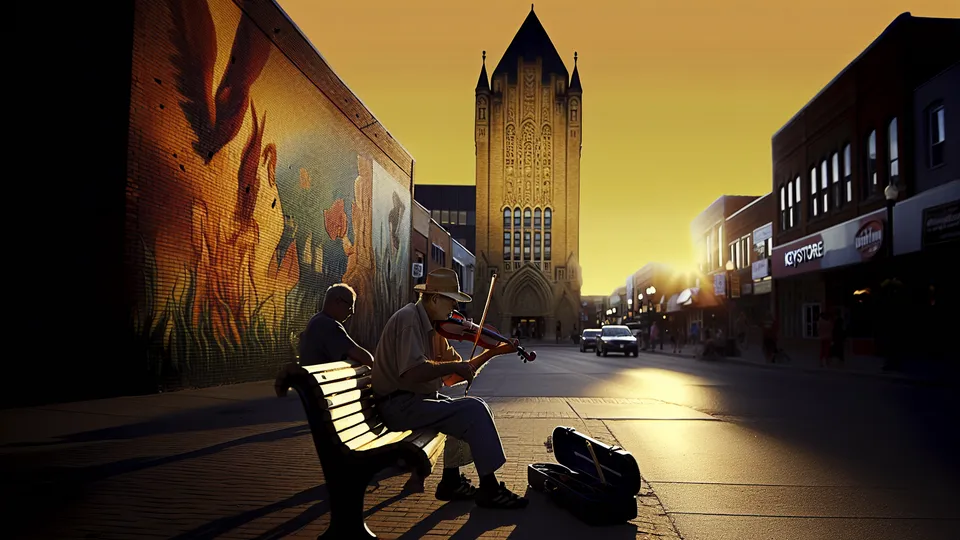
Yet the city's cultural life is not only institutional. In recent decades grassroots initiatives have reshaped downtown and neighbourhood life. Murals bloom on brick facades, each a public argument about history and hope. A handful of artist-run studios, squeezed into former warehouses, function as incubators where graduates from the university collaborate with elders to teach printmaking to youth. Local theatre companies stage plays that refuse to sanitize the region's past — bringing to light stories of labour, migration, and Indigenous presence that rarely fit into postcard narratives.
These developments have human faces. Take, for example, a potter who began teaching weekly classes at a community centre after losing her gallery commissions during the 2008 downturn. Her students were teenagers, retired miners, newcomers learning English, and single parents; the classes became de facto community counseling. 'We showed up with clay and left with something else — an argument, an apology, a laugh,' she told me. Or consider the Indigenous storyteller who partnered with the university and the gallery to create a youth residency focusing on language reclamation and beadwork. The residency turned traditional motifs into contemporary installations, and in doing so, it created new audiences and a safer civic language for discussing colonial legacies.
The arts here have proved adaptive — a feature that matters in an era of climate anxiety, demographic shifts, and economic precarity. When the pandemic shuttered theatres and galleries, Brandon's creative community pivoted quickly: outdoor installations, drive-in concerts, and social-media art swaps preserved both livelihoods and social ties. Those tactical innovations have reshaped expectations about accessibility and the uses of public space. What began as emergency practice is now part of a longer conversation about who the city is for.
But there are constraints. Funding remains uneven, and regional cultural infrastructures too often depend on a handful of committed volunteers and the goodwill of municipal budgets that are themselves under pressure. Artists still report leaving for larger markets because of limited full-time roles, and public spaces for rehearsals and small-scale production are finite. The challenge for Brandon is not just to celebrate what exists but to build reliable systems — affordable studio space, sustained arts education in public schools, and multi-year funding streams — that let creativity thrive as vocation, not just avocation.
Looking forward, the most promising thread is intergenerational exchange. As elders teach traditional craft and young people rework those forms into new media, a reciprocity develops: history remains alive and unfinished, usable rather than museum-accurate. If municipal planners and cultural funders respond by investing in shared spaces rather than siloed programs, Brandon could model a regional cultural ecology that other prairie cities watch closely.
The gallery opening that evening ended as it began — with conversation. People lingered under the sodium streetlights, the city's black silhouette behind them. In the warm residue of that room, art looked less like luxury and more like infrastructure: a way to remember, to argue, and to invent. For Westman, that is the enduring lesson — that culture stitches disparate lives into a civic fabric strong enough to survive storms, warm enough to incubate new futures.