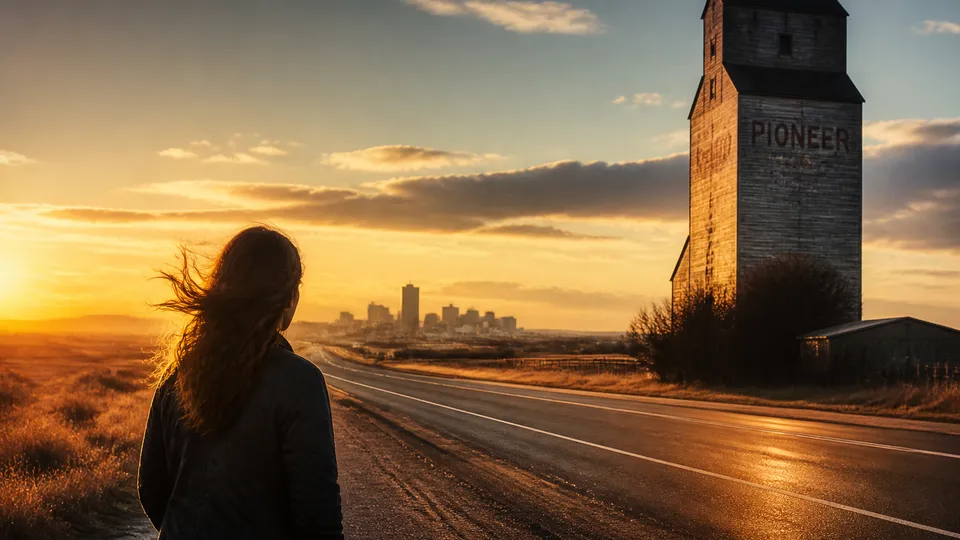
On a late October morning the silhouette of a wooden grain elevator still stood against a low, brittle sky outside a small Westman town. For decades it had been both landmark and ledger—an axis for local memory where farmers brought bushels, gossip, and the day’s anxieties. Now its boards bore graffiti and missing planks; the highway bypass hum of semis had become the new metronome. Watching a grandson of one of the elevator’s original operators run a hand along weathered beams, you could feel the weight of transitions: the tangible loss, and the pragmatic acceptance that accompanies regional reinvention.
This scene repeats itself across the Westman region—Brandon and its constellation of towns—where the forces that created the modern prairie intersect with the human work of holding community together. That intersection is where history matters most: not in abstract dates, but in the lives reoriented by railways, by mechanization, by new institutions such as Brandon University, and by the slow, steady influence of Indigenous communities whose stewardship of the land precedes settler narratives.
Brandon’s rise in the 1880s was inseparable from the iron thread of the railway. Tracks that cut across the prairie stitched remote homesteads into markets, and towns clustered around depots. Grain elevators—once a forest of white and silver teeth on horizonlines—were the visible infrastructure of a commodity economy. They were also community centers where harvesters exchanged news, where seasonal labour rhythms shaped family life.
Through the twentieth century, waves of technological change—larger combines, improved roads, containerized shipping—increased yields and decreased the number of hands needed. The economic logic of scale favored consolidation: small elevators closed, service centers shifted, and many farmsteads consolidated into larger operations. Those shifts have been double-edged. They bolstered productivity and global competitiveness, yet hollowed out some towns and redefined the social architecture of rural life.
A Brandon University historian put it succinctly: "The region's identity has always been negotiated between the land and those who work it." That negotiation has meant compromise and creativity, bitter endings and pragmatic new beginnings.
Brandon today is more than a junction of roads and rails. Its university, health-care facilities, and arts communities have become anchors that redistribute economic and cultural activity back into the region. Brandon University’s classrooms hum with students who are the first in their families to pursue postsecondary education, while the Kerry Vickar Centre for the Arts and community festivals animate downtown streets.
Equally important are quieter forms of civic resilience: community co-ops that resurrect local grain handling, food hubs that reconnect producers to consumers, and Indigenous-led enterprises that assert both sovereignty and partnership in land management. The Sioux Valley Dakota Nation and other Treaty 2 communities maintain deep ties to this region. Any honest account of Westman’s development must begin from Indigenous presence and the ongoing work of reconciliation in economic and environmental stewardship.
The region’s economic story in recent decades has been one of diversification under pressure. Energy prospects in places like Virden—paired with long-standing agricultural foundations—created patchwork booms. But global markets, trade disruptions, and climate variability meant that prosperity was often unpredictable. Farmers have had to adopt new crops, smarter rotations, and precision technologies to keep margins viable. At the same time, rural municipalities have experimented with renewable energy projects, small-scale manufacturing, and tourism that leans into prairie landscapes rather than pretending they are empty.
One local farmer described the terrain of risk: "We plan our budgets like we used to plan for frost—always with a margin, always ready to recalibrate." That pragmatism has led to surprising innovations: cover-crop trials, carbon-sequestration pilot projects, and collaborations between researchers at Brandon University and local producers.
The forward-looking Westman is not a single blueprint but a set of practices that foreground collaboration, respect for place, and adaptive governance. Broadband expansion and remote-work possibilities change the calculus for young families deciding whether to stay. Investments in health care and postsecondary training anchor skilled workers. Indigenous-led land management and municipal partnerships open new pathways for ecological resilience and shared prosperity.
But policy choices matter. Supporting mid-sized towns as service hubs, investing in rural education and child care, and funding climate-smart agricultural extension services are not glamorous headlines. They are the slow work that preserves the social infrastructure that once clustered around depots and elevators.
Westman’s story is neither a lament about what has vanished nor a boosterish tale of triumphant reinvention. It is a community portrait of people who transform loss into new forms of belonging—farmers who experiment with regenerative systems, students who bring urban know-how back to Main Street, Indigenous entrepreneurs who redraw relationships to land and economy.
The region’s past shows how material infrastructure—tracks, elevators, highways, classrooms—shapes who we become. Its present asks whether communities can stitch new forms of social capital onto that physical frame. If the morning wind still carries the smell of cut prairie, it is because lives continue to be weathered and remade here, with patience, creativity, and a conviction that the next chapter of Westman will be written as much by the smallest towns as by the city of Brandon.