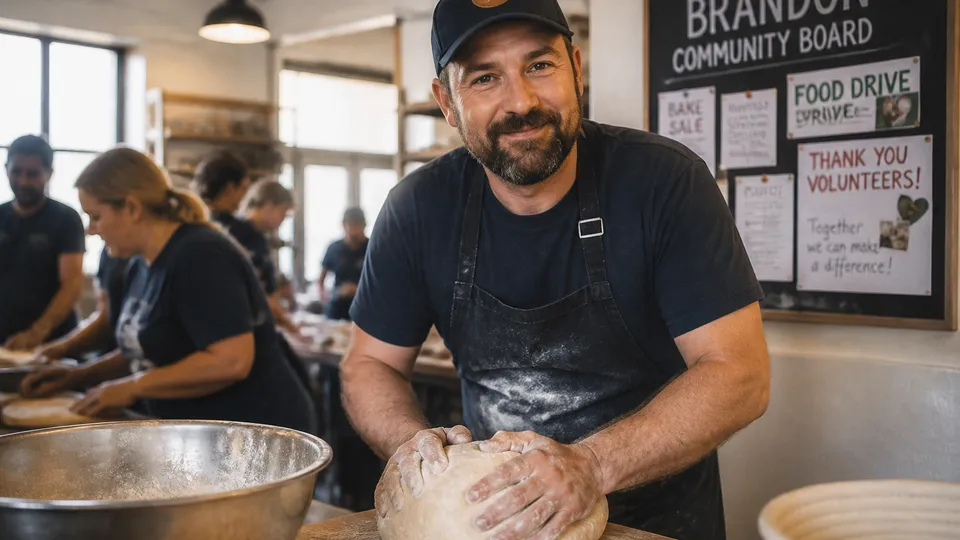
In the early light of a Brandon morning, the front windows of Prairie Hearth Café fog with the breath of ovens and conversation. The café sits on a modest corner two blocks from the Assiniboine River, its name stitched into a hand-painted sign that reads less like a brand and more like a promise. For nearly a decade, the promise has belonged to Maya Desai, a soft-spoken entrepreneur who came to Westman in 2011 and, through the ordinary work of baking and hospitality, built an infrastructure of care.
The first time I meet Maya she is flour-dusted, quick to laugh, and deliberate in how she speaks about the people who come through her door. 'This isn't about being a hero,' she says, pushing a tray of cinnamon buns toward a neighbor. 'It's about noticing what people already do and plugging a few resources in where there are gaps.' That attention to ordinary needs is what made Prairie Hearth something other than a business: a place where small operational choices became a canvas for civic response.
What started in 2014 as a 12-seat bakery has expanded into a local institution. Maya's innovations have been pragmatic: a volunteer roster that runs a Saturday soup program; an apprentice cohort that pays youth to learn culinary and bookkeeping skills; a ' hours' policy allowing staff to volunteer during paid time. Yet it is the way these programs knit together that has mattered. Prairie Hearth's Saturday soup began as a response to seasonal hunger, but it has grown into a weekly ritual attended by seniors, single parents, and students. 'I come for the soup, but I stay for the people,' says Tom, a retired machinist who has been a regular for three years. 'We watch out for one another now.'
Maya insists on metrics but refuses to let numbers be the only story. Still, the numbers are telling. Since 2016 Prairie Hearth has coordinated more than 12,000 meal servings for community programs, mentored over 80 local youth through paid apprenticeships, and distributed close to $60,000 in small grants to neighborhood-led initiatives. Those grants, often $500–$2,000, have underwritten everything from school garden beds to emergency transit passes. For a city like Brandon, where municipal resources are stretched and nonprofit budgets are lean, civic nimbleness matters.
There are human moments behind these totals. Aaliyah, now 22, learned to manage a cash register, inventory, and a payroll spreadsheet at Prairie Hearth while supported by a part-time apprenticeship. 'I wanted to go to college, but my family needed me home,' she says. 'Maya gave me space and some pay. I learned skills that helped me get a job and finish my degree.' For Aaliyah, the café was a bridge; for Tom, it was a place to outwait loneliness. For the wider Westman community, it became a way to redistribute time and care.
Maya's approach is not purely benevolent; it treats local business as a civic actor. She forged partnerships with the Brandon Friendship Centre and the Westman Immigrant Services, understanding early that expertise is plural. Prairie Hearth hosts monthly pop-up clinics — legal aid one week, resume workshops another — and in 2019 the café helped organize a flood-relief kitchen that served evacuees and volunteers when the Souris River rose unexpectedly. 'Small businesses are flexible in ways larger systems aren't,' Maya says. 'We can pivot overnight if the community needs it.'
That agility has come at a personal cost. Maya speaks candidly about burnout and the tension between being a reliable resource and running a sustainable business. Staffing a café while organizing citywide volunteer efforts demanded new kinds of management and, at times, sacrifice. The solution was incremental: hiring a program coordinator, applying for foundation funding, and spreading leadership among volunteers. 'You can't be the only one carrying the mission,' she says. 'The work needs to be owned by the people it serves.'
Looking forward, Maya's ambitions are quietly expansive. Prairie Hearth is raising funds to convert its upstairs space into a community kitchen where food entrepreneurs can rent capacity at low cost and where after-school programs can teach culinary skills. She is also working with other Westman business owners to form a cooperative network for mutual aid during crises. The aim is not to replace municipal systems, she says, but to build redundancy and dignity into local support structures.
In a region often defined by its weather and geography, Maya's story is a reminder that civic life is made in kitchen corners and in the steady rotation of volunteers. 'Impact isn't always dramatic,' she reflects. 'It's consistent: a seat at the table, a steady paycheck, someone who notices.' In Brandon, those consistencies are shifting local expectations about what business can be: not only a place to buy bread, but a place where bread becomes a reason to care for one another.
Maya's work demonstrates how modest interventions, sustained over time, change how a community sees itself. If the future of Westman depends on networks of mutual care, Prairie Hearth offers a model — practical, human, and resolutely local — for how can seed shared life.