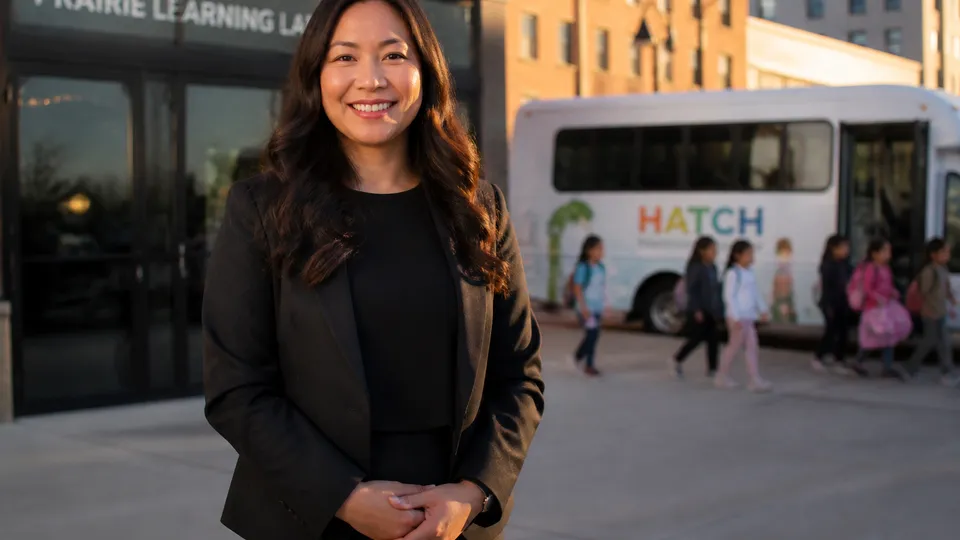
On a cool spring morning beside the Assiniboine River, a blue bus with the word 'HATCH' painted in chalky letters idles behind Prairie Learning Lab’s storefront on Princess Avenue. Inside, a dozen teenagers lean over soldering irons and laptops, mapping the circuitry of a small weather station. Outside, a woman in a high-visibility jacket explains a 3-D-printed hinge to a retired carpenter who has come to volunteer.
Claire Nguyen watches them with the kind of steady attention that belongs to someone who has both a plan and the patience to let it change. Nguyen founded Prairie Learning Lab in 2017 after teaching adult literacy courses at a college. She had watched students arrive with urgent needs that classroom hours alone could not address: unreliable internet, lack of job connections, cultural dissonance in curriculum. 'I realized learning doesn’t happen in a vacuum,' she says. 'It happens at kitchen tables, in repair shops, in kitchens, and on buses. We needed to build routes to those places.'
That insight became the Lab’s central experiment: stitch together formal learning, hands-on skill building, and civic context. Today the Lab operates a downtown learning hub, a mobile classroom known as the Hatch, and partnerships with 12 Westman schools and three local employers. Nguyen’s team reports working with more than 3,400 learners since launch, including roughly 200 youth in after-school programs each year, about 40 formal apprenticeships brokered with local businesses, and a consistent stream of adult learners returning for modular credentials.
What sets the Lab apart is not only the variety of its offerings but the careful choreography between them. In one program, grade-eight students from École Harrison are coached by an Indigenous elder before translating traditional harvesting practices into a seasonal data-mapping project with Brandon University interns. In another, newcomer parents attend evening workshops on digital literacy while their children receive tutoring across math and English in the same building. Employers come to the Lab not merely to recruit but to co-design small credentials that represent workplace-relevant skills: CNC operation, customer-service communication, and basic agricultural equipment maintenance.
There are human stories behind the numbers. Jordan Peters, now 24, dropped out of high school at 17 after a family illness. He began attending evening welding clinics at the Lab, then enrolled in a short-term certificate created with a local machine shop. 'They taught me how to hold a torch and how to talk to people in a shop,' Peters says. 'But more than that, they told me my experience counted here.' Within a year he had an apprenticeship and today supervises a crew that fabricates components for agribusiness equipment.
Nguyen credits the Lab’s early growth to a blend of small, strategic grants and an ethos of radical partnership. 'We don’t see schools, employers, or cultural organizations as separate silos,' she explains. 'We’re trying to build overlapping circles where learners can move between supports without starting over.' That has meant persuading a sometimes conservative funding landscape in Manitoba that stacking tiny, flexible programs can produce measurable outcomes: higher job placement, improved high-school completion rates among participants, and increased local retention of young adults.
Yet the work is not without friction. The mobile Hatch requires a driver and a technician—roles that are costly to sustain. Employers want standardized certifications, while many learners need bespoke, trauma-informed supports that defy simple metrics. Nguyen has navigated these tensions by prioritizing transparency: publishing local outcomes, convening quarterly advisory circles with elders and employers, and piloting digital micro-credentials that stack into provincially recognized pathways.
The Lab has also become a place where cultural curriculum is not an add-on but a structural element. A recent summer program paired Métis craft practices with design thinking, resulting in a small incubator for traditional goods sold at Market Square. 'That program gave me my confidence back,' says participant Tina Cardinal, who now teaches beadwork workshops at the Lab. 'People are actually listening to our knowledge.'
Looking forward, Nguyen wants to expand the Hatch’s route into smaller towns like Neepawa and Virden and to replicate the Lab’s modular credential model with regional post-secondary partners. She is negotiating a pilot with Brandon University to create a credit-bearing pathway for adult learners whose experience is recognized through workplace assessments.
'Our ambition is not to outgrow Brandon,' she says. 'It’s to make sure Brandon grows with the people who live here.' The Lab, in other words, is less a single institution than a new kind of civic infrastructure: flexible enough to travel, anchored enough to create trust, and designed to make learning legible to employers and learners alike.
If its early decades are any measure, Prairie Learning Lab has been quietly changing expectations about who counts as a learner and what counts as education in Westman. The real test will be whether those experiments can be institutionalized without losing the very improvisational care that made them effective. For now, as the bus door closes and a group of students head toward the river with a freshly soldered sensor, the community around them—shopkeepers, elders, university students, and new Canadians—moves a little closer to an education that recognizes its own messy, human scale.