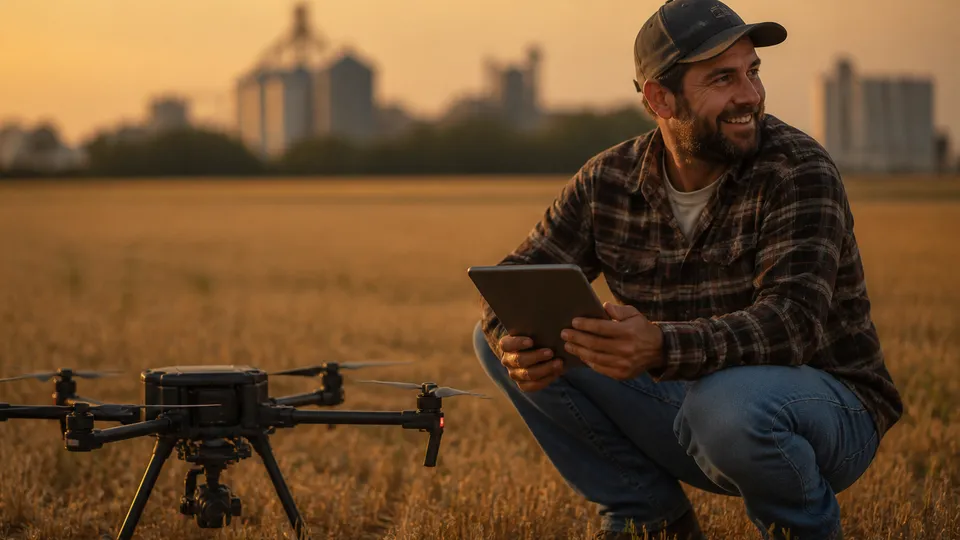
On a crisp April morning outside Brandon, a pickup idles at the edge of a field while a woman in a faded jacket scrolls through a tablet, parsing last season's yield maps. The soil here—heavy, dark prairie loam that has fed families for generations—shows the same furrows it always has, but the questions the farmer asks of it have changed. Where once decisions were handed down across kitchen tables, they are now negotiated with data, neighbors and researchers.
This is the quiet revolution sweeping through Westman. It is not one dramatic invention but a constellation of small, practical innovations: satellite imagery combined with soil probes; cover-crop trials organized by nearby universities; community grain storage outfitted with smart sensors; and young returnees bringing software skills to long-standing operations. Taken together, these shifts are altering how grain is grown, stored and sold—and how rural people imagine their future.
Precision agriculture has been part of prairie conversation for years, but locally the focus has moved from novelty to necessity. Farmers in the region report using variable-rate seeding and fertilization to coax more uniform yields out of heterogenous fields. ‘‘We used to walk the fields and make a best guess,’’ said Michael Hrycak, a third-generation farmer from Rapid City. ‘‘Now I can see where the phosphorus is hanging on, where the spring ran off. It doesn’t replace experience, but it stretches it farther.’’
These tools matter because Westman’s weather has become less predictable. Warmer winters, an earlier thaw and intense spring rains are changing planting windows and disease pressures for wheat, canola and pulses. Rather than rely on one-size-fits-all prescriptions, farmers are increasingly running their own small trials—different seed rates, staggered planting dates, and inter-seeding cover crops—to understand what works on their land.
Brandon’s research community has leaned into that farmer-led curiosity. Collaborative plots run through regional extension services and the Brandon Research and Development Centre create a bridge between controlled science and the messy realities of family farms. Researchers measure soil carbon under reduced-till regimes; farmers measure whether those practices make economic sense when fuel, machinery and time are tallied.
One recent local initiative pooled several neighbors’ fields to test winter wheat varieties under the same management. The results mattered because they were replicable—from the north of Virden to the southeast of Brandon—yielding data that farmers could trust because it came from fields that looked and felt like their own.
in Westman is not only technological; it is social. Co-operative approaches—shared equipment, collective grain marketing and producer-led research groups—have lowered the barrier to experimentation. For smaller operators, renting a variable-rate seeder or buying access to drone imagery is easier when risk and cost are shared.
Youth play a surprising role. A number of returnees—often trained in software, data science or agronomy in urban centers—are introducing tools for on-farm data management and remote monitoring. ‘‘My nephew set up grain-bin sensors for us last fall,’’ said Lillian Poirier, who farms near Brandon. ‘‘I get texts if the temperature creeps up. It saved a load of grain, and it saved a sleepless night.’’ These practical returns are reshaping the culture of care on farms: is an extension of familial stewardship, not a replacement.
Still, innovation has limits. Broadband gaps in outlying municipalities constrain the flow of data; small operators wrestle with upfront costs; and some practices that are environmentally promising—diverse rotations, longer-term no-till—can complicate cash flow in early years. Policy remains a deciding factor. Access to cost-shared programs, low-interest loans for equipment, and infrastructure investments like rural internet will determine which innovations scale.
Equally important is attention to knowledge transfer. The best precision tools do little good if farmers lack training or if local institutions do not translate research into actionable, place-based advice.
What feels new in Westman is less the technology than the social architecture around it. Data platforms designed for aggregation across farms, farmer-led research trials, and a more porous relationship between universities and production agriculture are knitting a regional system that can respond to climate variability. The work is iterative: small experiments, repeated and shared, produce local wisdom faster than any single pilot.
At its heart, this agricultural innovation is about stewardship and continuity. Farmers I spoke with express a pragmatic optimism—aware of constraints but committed to improvement. ‘‘We’re not chasing gadgets,’’ Hrycak said. ‘‘We’re trying to make sure the farm we pass on is better than the one we inherited.’’
If Westman succeeds, it will be because it recognized innovation as a communal practice—something grown, not bought; taught, not marketed; and bound to the same rhythms of weather, family and soil that have always guided prairie life.