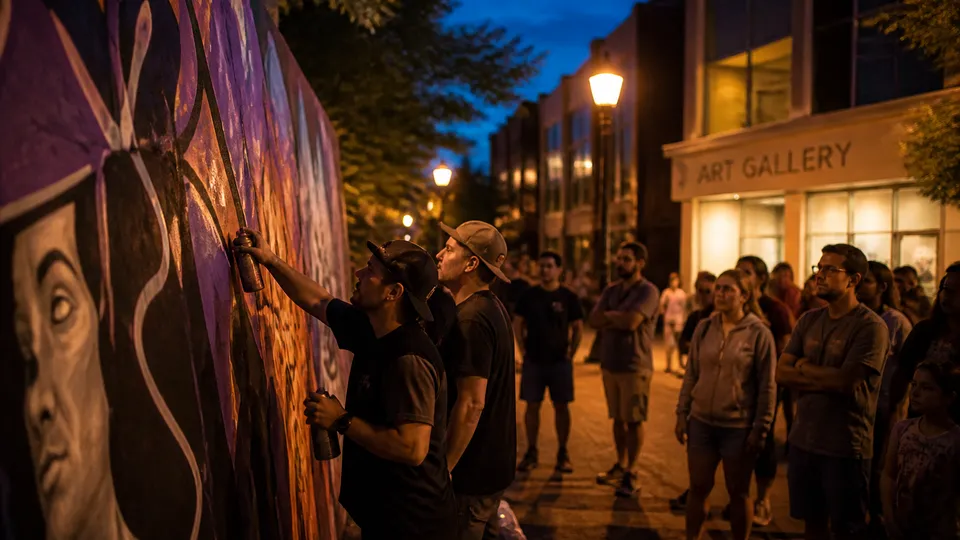
On a raw October evening in downtown Brandon, a dozen people gather beneath a newly finished mural on Princess Avenue. They are teachers, students, farmers home from the field, and an Elder who points out a motif drawn from the land. The mural captures the odd, intimate tether that binds Westman: prairie light and the people who have long worked under it, a history of migration and resettlement, and the stubborn, creative impulse to make meaning together.
The story of in Westman is not a straight line from patronage to prestige. It began in small, determined gestures: community halls where Ukrainian choirs and settler melodramas kept winter evenings bearable; kitchen tables where Indigenous beadwork and oral histories persisted in parallel and conversation; classrooms at Brandon University where a handful of teachers and students sought to expand the region's cultural vocabulary. Those early practices were practical and social, produced for weddings, memorials, school concerts, and harvest suppers. But they also shaped civic identity, coaxing a civic life out of dispersed prairie settlements.
By the late 20th century, institutions emerged to codify and broaden those practices: an art gallery that collected local works and hosted touring exhibitions, a university with a music program that trained performers and teachers, and community theatres that translated local stories to the stage. The Art Gallery of Southwestern Manitoba became a gathering place for visual artists and a place where the public could see the region reflected back at them. Brandon University supplied not only performers but cultural workers who went on to organize festivals, teach in schools, and seed arts programs in small towns across the region.
Those institutional forms mattered for another reason: they provided scaffolding during economic downturns. When commodity cycles depressed farm incomes and local industry tightened, arts organizations offered alternative economies of meaning and marginal income for artists. The visual arts, music, and theatre built cultural tourism that was modest but real. More importantly, they kept communities talking to each other. The resilience of Westman's cultural life is as much about economic adaptability as it is about aesthetics.
The human element is easiest to see in individual stories. There is a potter in Virden whose studio doubles as a community classroom. A playwright from Souris wrote a play about rural hospital closures that toured small towns, prompting public meetings that led to policy conversations. A Métis fiddler mentors youth ensembles at the community centre, insisting that repertoires include both contemporary arrangements and older tunes taught by Elders. These acts are both artistic and civic, gestures of care that knit neighborhoods into something more than a collection of households.
The last decade has pressed those capacities in new ways. Digital platforms expanded audiences but also revealed inequalities in access. The pandemic accelerated both and fragility: livestreamed concerts and virtual exhibitions sustained programs, but they also showed how dependent many local artists are on physical venues, markets, and tourism dollars. Simultaneously, conversations about reconciliation reshaped curatorial and programming choices. Galleries and theatres are increasingly collaborating with Indigenous artists and knowledge-keepers, creating work that acknowledges the land and its histories rather than erasing them.
Marie Dubois, director of a regional gallery, says that the work now is less about showcasing and more about remembering and repairing. She notes that projects which place Elders and youth in dialogue produce unexpectedly deep community engagement. That engagement translates into political will: municipal cultural plans, new funding priorities, and creative reuse of vacant storefronts into affordable studio space.
Looking ahead, the region's cultural future hinges on a few concrete commitments. First, cross-sector partnerships between municipalities, universities, and local businesses can underwrite touring circuits that keep artists in the region rather than sending them away. Second, investments in affordable live-work spaces will retain younger artists who otherwise gravitate to larger centres. Third, sustained collaboration with Indigenous communities must be framed by respect, long-term compensation, and co-governance of cultural projects.
None of this requires grand gestures. Small things—matching grants for community murals, paid mentorships for young Indigenous artists, a reliable schedule of school-based residencies—accumulate into durable cultural infrastructure. The arts in Westman have always been cumulative: a choir here, a gallery show there, a play that sparks conversation—each one a stitch in a larger fabric.
The mural on Princess Avenue is, in that sense, emblematic. It will fade, will be painted over, will acquire new coats and voices. But for the people who stood under that October sky, it was a claim: that this place is worthy of stories, that art can help a community see itself, and that the prairie, long misread as empty, is in fact densely inhabited by memory and imagination. The challenge for Brandon and its neighbours is to care for that density—through funding, policy, and simple everyday practices of listening—so that the arts continue to do what they have always done here: reframe the past, repair the present, and sketch the contours of a shared future.