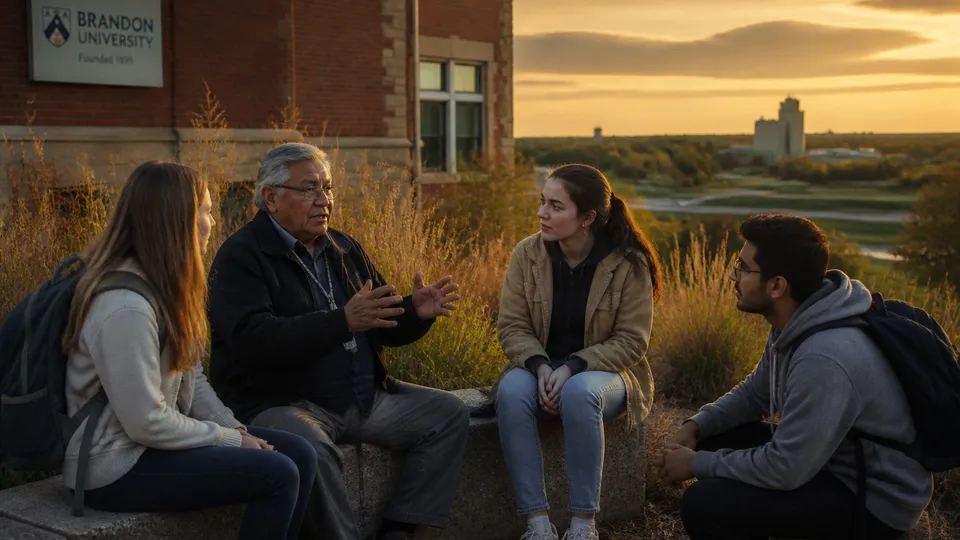
The classroom on the second floor of an old brick building in downtown Brandon is modest: a cluster of tables, a whiteboard densely scrawled with timelines, and sunlight that tracks across the floor in the late afternoon. On a Tuesday this spring, the group gathered there includes a high-school student preparing for university, a woman in her fifties returning to finish a diploma she set aside decades ago, and an elder from a neighbouring First Nation who has come to lead a session on seasonal knowledge and land-based learning.
For many in Westman, education no longer fits the neat pipeline of K–12, then post-secondary, then employment. It is iterative, intergenerational, and porous—moving between centres, college workshops, and open-air gatherings. The scene in Brandon is emblematic of a broader shift: institutions and neighbourhoods are knitting together formal credentials and local knowledges to respond to demographic change, labour shortages, and a renewed emphasis on reconciliation.
'When I first signed up, I was nervous,' says Maria Jensen, a trainee in a diesel mechanics bridging program at Assiniboine Community College. 'But the instructors treat us like neighbours, not numbers. They ask what we need for our lives, not just what the curriculum requires.' Maria's comment captures something tangible in Westman: learning is being reframed around usefulness and dignity as much as around accreditation.
Brandon University and Assiniboine Community College have long been anchors in the region. In recent years they have deepened partnerships with Prairie Mountain school divisions, local employers, and Indigenous communities to create flexible pathways. These include condensed courses for farm mechanics, evening classes for parents completing high-school equivalency, and collaborative workshops where Elders and scientists co-teach environmental science using the language of place.
Elder Rose Sinclair, who grew up on the prairies and now works with student cohorts across campuses, describes the importance of context.
'Our children learn differently when the land speaks with us,' she says. 'Combining those teachings with the new skills they need—for trades, for nursing, for —makes education whole again.'
Programs that once felt peripheral have become central. Apprenticeship and trades training respond to acute labour gaps in agriculture, manufacturing, and health care across Westman. Adult learning centres have seen an influx of students in their thirties and fifties seeking reskilling or credentials that local economies increasingly demand. Meanwhile, digital classrooms—honed during the pandemic—have not replaced in-person experience so much as extended it, allowing a learner in a rural town like Neepawa to attend an interactive lab hosted in Brandon or to take a blended Indigenous studies course co-designed with community partners.
The human impact of these changes is specific and immediate. A recent graduate from a community nursing program returned to her small town clinic in Souris, extending hours and care to seniors who previously travelled hours for treatment. A group of high-school students launched a social enterprise that refurbishes school equipment, creating summer jobs while filling a local need. Families describe a renewed sense of possibility—education once seen as an out-of-town rite of passage is becoming a local asset.
That optimism is tempered by structural challenges. Funding models often favour traditional full-time enrolment over the modular, community-integrated learning that is surging in demand. Broadband gaps remain a stubborn barrier in some rural reaches, and recruitment of teachers—especially in specialized trades and in culturally responsive Indigenous pedagogy—still taxes local systems. Local leaders speak candidly about the need to align provincial policy with the on-the-ground realities of a dispersed, aging region in search of young talent and sustainable livelihoods.
Yet the forward-looking energy here is notable. Partnerships between colleges and employers are producing micro-credentials that stack into diplomas. Community learning hubs in Brandon’s downtown are functioning as places where parents, youth, Elders, and newcomers exchange skills across generations. Importantly, the work of decolonizing curricula—bringing Indigenous languages, histories, and ecological practices into classrooms—has shifted from marginal projects to programmatic commitments.
If there is a through-line, it is this: education in Westman has become civic work. It is not merely about transmitting knowledge but about rebuilding local capacity—economic, cultural, and social—so that communities can remain vibrant and self-determining. The people who enact this work are teachers and students, yes, but also shop owners who offer apprenticeships, Elders who teach by the river, employers who co-design curricula, and municipal leaders who see lifelong learning as infrastructure as crucial as roads or water.
On that quiet afternoon in Brandon, as the sun slid west and the class prepared to disperse, the conversation folded seamlessly from mechanical schematics to seasonal practices and then to plans for a community open house. There is a kind of pragmatism at play: learning must answer immediate needs, but it also carries the slower work of cultural continuity and civic renewal. In Westman, education has become a field where the prairie’s possibilities are actively shaped—not by distant policy papers but by local people who are, quietly and insistently, making space to learn together.