The morning light arrived thin and prairie-wide, a pale wash over the Assiniboine visible through the tall windows of the auditorium. Folding chairs filled with coats and coffee cups faced a patchwork of posters: hand-drawn maps of watershed boundaries, seed packets taped to flyers, and lists of small-dollar grants. The event—organized by a coalition of local non-profits, university researchers and grassroots volunteers—felt less like a conference and more like a neighbourhood conversation stretched across a full day.
Organizers called it a forum for resilience, a deliberate word that carried both municipal planning jargon and something more intimate: how a region learns to live with change. Panels threaded big ideas with grounded experiments—how to keep topsoil in place when spring runs early, where to fit a rain garden in a compact downtown lot, how to translate seasonal memory into a municipal storm plan.
"We can't treat like a report you tick off," said a farmer from Rivers during the afternoon breakout on regenerative practices. "It's what you do before, during, and after the weather turns on you." He spoke about cover-crop mixes he began introducing five years ago: rye and oats to hold soil, clover for nitrogen, occasional prairie legumes. The switch cost him mornings of trial and error and months of patient trust-building with his bank officer, he admitted, but reduced the dust in his yard and made the field more forgiving after late-season rains.
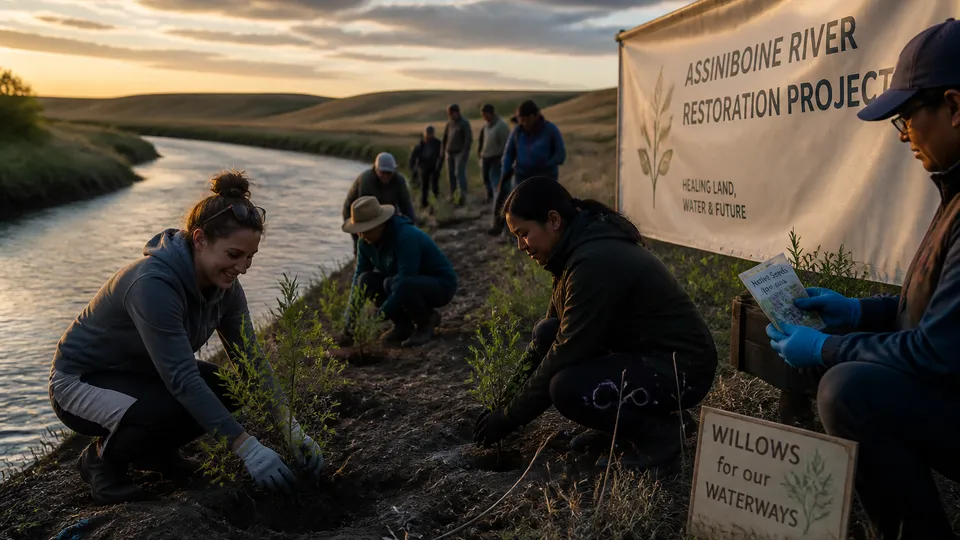
The practical tone was everywhere. In a demonstration tent volunteers showed how willow cuttings are planted along an eroded bend of the Assiniboine, roots gripping newly loosened banks. Conservation district staff described a multi-year pilot that combined small woody installations, native prairie buffers and adjusted mowing schedules to encourage wetland recovery on working acreage. "It's modest work, but it changes the hydraulics at a local scale," one coordinator noted, meaning floods and flows behaved differently when plant roots and small terraces slowed water.
Beyond technical fixes, the forum foregrounded rhythms of knowledge that are rarely found in grant applications. An elder from a nearby First Nation walked the room through a seasonal map drawn from memory: ice thickness, bird migration windows, places where medicinal plants were gathered after thaw. "We mark time by what the land shows us," she said. Her remarks were not romantic; they were procedural. Younger farmers asked how that knowledge might be documented without being flattened into academic categories. Planners leaned in, recognizing a mutual need: the municipality needed granular seasonal intelligence, and Indigenous elders wanted their knowledge to be respected and compensated, not co-opted.
Students joined with equal seriousness. A group from a local college presented a proposal for a community repair cafe and tool library to reduce waste and circulate skills. They argued that material resilience—repairing boots, mending tarps, refurbishing small engines—was a frontline climate strategy in a place where supply chains can be long and winter breaks things.
If the language in some panels was technical—permeable pavement, carbon sequestration potential—the mood never felt detached. In the hallway, a municipal planner and a retired schoolteacher traded notes about a rain garden outside the downtown library. "It'll be one less flooded basement this spring," the teacher said, and both laughed at the modest politics of that victory. Small fixes that keep household budgets steady, protect crops from erosion, or bring a group of students and elders together are the civic wins people remember.
The forum did not paper over impediments. Funding cycles are short; provincial policy often lags the urgency communities feel; and the revenue models for small farmers adopting regenerative practices are patchy at best. Speakers spoke candidly about the need to shift incentives—subsidies that reward soil-building practices, procurement policies that prioritise local resilience, and rural broadband that lets weather stations and sensors talk to one another in real time.
Still, the forward-looking notes were tangible. A neighbourhood microgrant program announced at the end of the day promised small but immediate investments: native plant nurseries in community gardens, stipends for Indigenous knowledge holders to co-design curriculum, a shared tractor hour bank for smallholders testing cover-crop transitions. These are not silver bullets. They are, instead, the kind of investments that let a community translate an idea into a new routine.
By dusk people drifted toward the riverbank, pairing up to plant the last of the willow cuttings. Hands were muddy, and the conversation—about policy, soil biology, family farms, and the next generation—kept circling back to what the work demands: patience, careful listening, and the steady accrual of small changes. If resilience in Westman is to mean anything beyond rhetoric, it will be measured by these neighborhood-scale practices that protect livelihoods and memory alike.
The forum closed with a short invitation: sign up, volunteer, test a plot. There was no grand declaration, no tidy timeline. Instead, there was an open ledger of projects and a growing list of people willing to try them. In that ordinary ledger lies the most persuasive promise: that environmental stewardship in Brandon and the surrounding prairie is less about heroic leaps and more about deliberate, persistent repair.