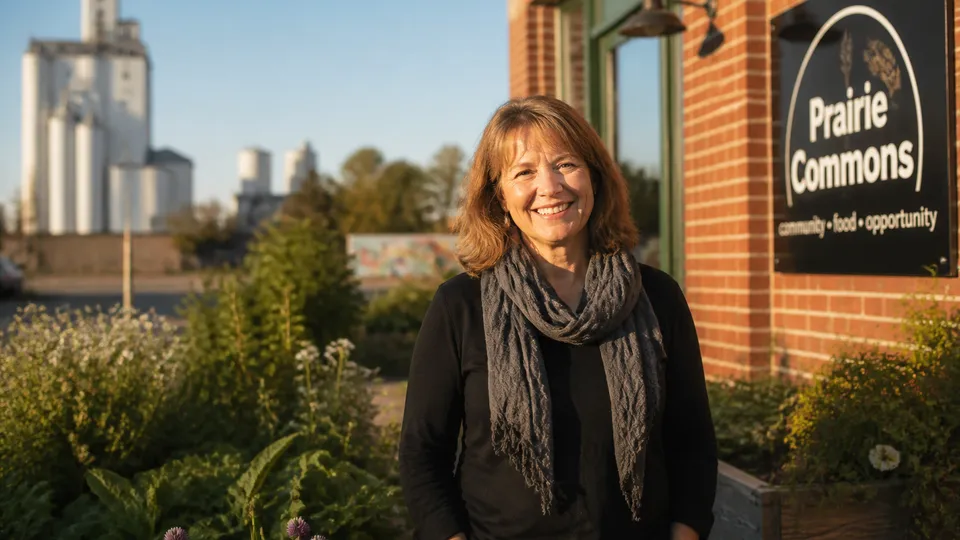
The door to 10th Street still sticks in the winter, the old latch complaining as Claire MacKinnon pushes it open. For a decade that sound has been the same: a small resistance, then release; a neighborhood sighing as something new takes root. Prairie Commons began as one boarded storefront among many in downtown Brandon, an after-image of a city shifting toward suburban malls and commuter life. Today the building hums: a bakery timer beeping, a vertical-farm LED bank glowing faintly, a classroom of young people sketching a business logo on butcher paper.
MacKinnon is not a flashy founder. She wears a wool coat and speaks like someone who has learned to listen before prescribing. Her biography reads like a catalogue of local ties—Brandon College coursework, a stint in Winnipeg’s development scene, and a return in the wake of 2010’s economic lull when she saw an opening where others only saw vacancies. "I didn’t have to invent the need," she says. "This place already wanted to be something else. I just tried to hold the pieces together long enough for people to see it."
Prairie Commons is a hybrid: coworking desks, a commercial kitchen rented at sliding-scale rates, an incubator for food producers, and a small social-enterprise farm on the roof that supplies restaurants and the Saturday market. It also houses GrowWest, a hands-on training program for youth and newcomers that pairs technical skills with business mentorship. The model is intentionally porous—profit-bearing microenterprises sit beside subsidized vocational training, an arrangement MacKinnon calls "practical solidarity."
The results are pragmatic and measurable. Savour & Co., a sourdough bakery that began in Prairie Commons’ shared kitchen, moved into its own storefront last year and now supplies three cafés and the Brandon General Hospital patient cafeteria. GrowWest graduates have started produce carts that serve evening markets and supply two local restaurants with salad greens during the lean winter months. Vacancy on the block fell noticeably; evening foot traffic increased when a handful of new eateries opened in spaces that had been empty for years.
These outcomes did not arrive on optimism alone. MacKinnon cobbled together a mix of municipal seed funding, a federal rural economic development grant, and patient loans from a community credit union. She forged institutional partnerships—Brandon University students in agriculture and business do practicum placements; the local Indigenous Friendship Centre co-runs a cultural programming series in the Commons’ back room; Manitoba Agriculture provided technical support for the rooftop farm experiment. "Partnerships are the scaffolding," she says. "They let us build beyond what any of us could do alone."
The human stories are what linger. Jamal Ahmed, 22, enrolled in GrowWest after a high-school program fell short of employment promises. "I learned how to run a cooler, how to track inventory, how to talk to vendors," he says. "But more than that, I learned I could run something. That feeling changed how I saw myself in the city." An elder from a neighbouring First Nation, Evelyn Peters, brings lessons in seed-keeping and Indigenous foodways to a monthly workshop that feeds both the rooftop beds and participants’ curiosity.
MacKinnon is candid about constraints. Zoning rules, limited transit options, and thin local capital markets make scaling difficult. "It’s easier to start here than to scale here," she says. "We can pilot a lot, but replication across Westman requires policy shifts and patient investors." Part of her work now is less about running another bakery or farm and more about building infrastructure—shared processing capacity that can serve multiple towns, standardized training curricula for rural hospitality and agri-business, and a procurement campaign to convince institutions to buy locally.
Her next move is deliberately outward. Prairie Commons has begun advising a similar project in Virden and is exploring a franchisable cooperative model that allows small towns to adapt the Commons’ components to their needs. There is also an experimental plan underway to trial cold-hardy, low-input greenhouse crops that could lengthen the local growing season without heavy energy demands.
What sets this story apart from typical downtown-renewal narratives is the scale at which ordinary people are entrusted with change. MacKinnon’s enterprise refuses the binary of market success or charity; it seeks to remap the everyday economy so that business training, cultural exchange, and resilient food supply are woven together. The visible improvements—new shopfronts, a busier market, employment for young people—are the smallest part of the story. The larger shift is the steady accumulation of capacity: people who can manage a payroll, an elevator pitch, an irrigation schedule.
Standing in the Commons kitchen on a cold afternoon, MacKinnon watches a group of new entrepreneurs plate a trial dish for a test dinner. "I want this city to be a place where small bets add up," she says. "Where a kid who learned to bake here can eventually teach the next one. That’s how a region changes—incrementally, and then, all at once." If Brandon and the surrounding towns are to contend with shifting demographics, climate uncertainty, and the drain of young people to larger cities, models like Prairie Commons offer a quiet, iterative pathway: not a miracle cure, but a set of practices that make community economies more adaptive, inclusive, and durable.