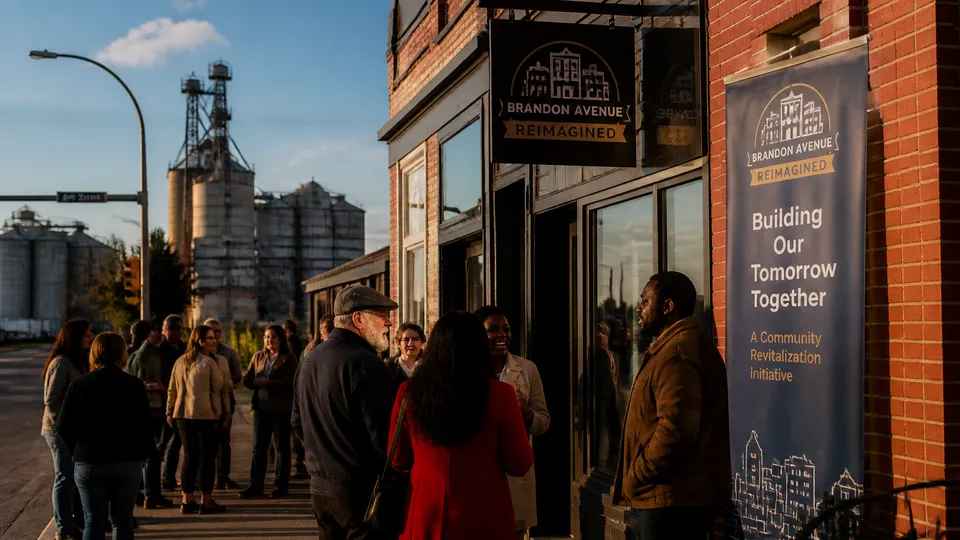
On a crisp morning in the heart of Brandon, people converge at a small refurbished storefront called The Junction — a shared office, a gallery, a meeting place for a dozen grassroots projects. Outside, a mural of wheat and sky wraps the brick corner; inside, a young carpenter and a retired nurse argue gently about zoning bylaws and childcare hours. The conversation is practical and immediate: where will people live, where will they work, and how will a sprawling region with a dozen small towns and significant Indigenous communities reconnect its social and economic fabric?
This is not a top-down master plan. It is the patient work of neighbors, municipal staff, university researchers, and Indigenous leaders who, over the past five years, have stitched together a patchwork of initiatives under the informal umbrella people call Westman Together. What began as a response to shuttered storefronts and a housing shortage has become a broader experiment in regional governance—one that balances economic opportunity with social infrastructure and ecological resilience.
"We started with small things that mattered to people," says Ethan Carter, an urban planner who helped convene the early forums. "A laundromat here, a co-op there. Those wins built trust. Once people felt they would be heard, we could tackle big, contentious questions: how to site affordable housing, how to improve transit between towns, how to ensure Indigenous participation in decisions that affect treaty lands."
The human scale of the project is its strength. In Rivers, a town 40 minutes east, the old hardware store was converted into a woodshop and apprenticeship hub run by Indigenous carpenters and newcomers. "When I was young there were jobs and a place to come together," says Chief Raymond Sinclair of a nearby First Nation. "We wanted our young people to see that building a future can mean building with your hands, and building it in a way that respects the land."
In Brandon, the local housing trust has partnered with provincial agencies and private lenders to create modular housing clusters—compact, energy-efficient units arranged around shared gardens and childcare spaces. These clusters are not merely residences but civic infrastructure: they include kitchens, after-school rooms, and flexible spaces for trainings and pop-up markets. "The model reduces isolation and cuts per-unit costs because services are shared," explains Dr. Lena Plett from Brandon University, who studied the first cohort of tenants. "When people have places that are designed for life, they invest in them."
Economic vitality arrives in linked, sometimes surprising ways. A broadband initiative funded by a mix of municipal levies and federal grants has allowed micro-enterprises—graphic designers, e-commerce sellers, agri-tech startups—to remain in small towns rather than congregate in the city. "I can run my consulting business out of my farmhouse and still take a client call at 8 p.m.," says Maria Lavoie, who launched an online bookstore that celebrates prairie authors. "That possibility makes it viable to stay and contributes to a more distributed, resilient economy."
The initiative places coherence around climate and land use, too. Floodplain restoration projects outside Souris reintroduced wetlands that provide habitat while reducing the risk of sudden damages downstream. Farmers have taken part in agroforestry pilots that aim to stabilize soil, capture carbon, and create new income streams. " isn’t an add-on; it’s integrated into the way we plan roads, housing, and markets," says Carter.
Not all of the work is tidy. Negotiation over land, water, and municipal taxes has sometimes fractured goodwill. Small towns worry about losing identity; developers press for faster approvals. Funding is episodic—patchy grants followed by uncertain renewals—and that creates start-stop momentum for community projects. Still, the pattern of local wins—new apartments in Brandon, revitalized main streets in Virden and Neepawa, apprenticeship wages that keep youth in the region—has compounded into real change.
The human stories are what give the initiative gravitas. There is the single mother who moved from temporary housing into a modular cluster and now co-manages the shared childcare space; the Syrian baker who opened a shop on Brandon’s north end after a small business grant and now supplies school cafeterias; the retired teacher who organizes English classes and literacy circles in the Junction lobby. These are not anecdotes of charity. They are the outcomes of systems reoriented to create opportunity where it was fading.
Looking forward, leaders emphasize governance and measurement. The coalition is drafting a compact to formalize revenue-sharing for cross-municipal services, while researchers are piloting a dashboard to track housing stability, job creation, and ecosystem health. "We need long-term financing and clear accountability," says Chief Sinclair. "If we can bind resources to outcomes and keep Indigenous voices at the table, this region can be a model for others."
The Westman experiment—part pragmatic problem-solving, part civic apprenticeship—makes evident a particular truth about rural redevelopment: small-scale projects, grounded in local knowledge and connected across municipal lines, can alter expectations about what life on the prairie can be. The work is slow and often messy, but the result is not merely new buildings or jobs; it is renewed possibility. In the Junction that morning, as stewards and makers drafted plans over coffee, an old storefront felt, briefly and wonderfully, like a town hall for a region learning to imagine itself whole again.