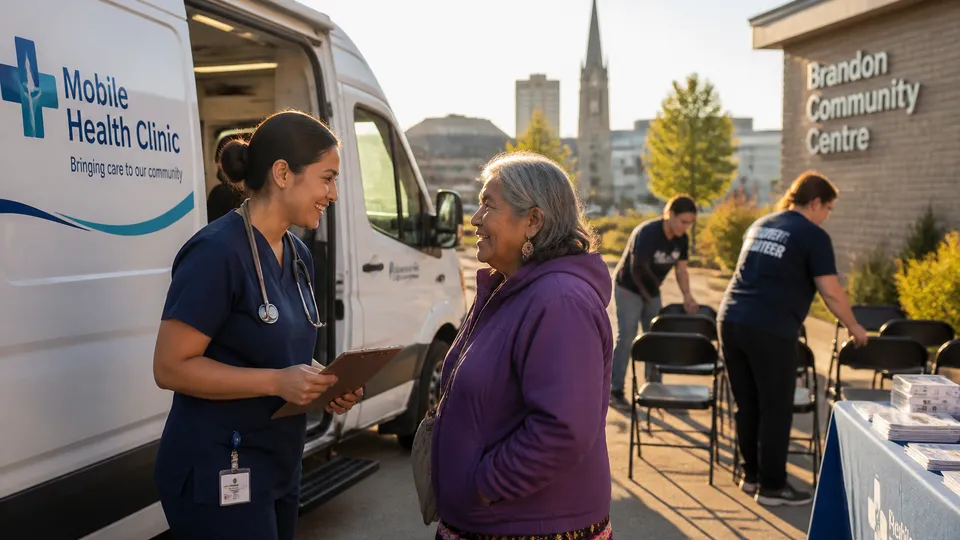
On a frost-bright morning in late March, a pale green van eased into the parking lot behind Brandon’s downtown community centre. Its doors unfolded like a small stage: an exam table, a folding desk, a kettle steaming away for tea. Across half a dozen lawn chairs, a woman named Evelyn waited with a scarf wound tight against the wind. She had driven thirty minutes from her farm outside Rivers for a follow-up on diabetes medication and a chance to talk about how loneliness had seeped into her days since her husband died.
“I used to cross the moon on him,” she said later, voice low. “Now I cross town for care.”
Evelyn’s journey is part of a quieter revolution in Westman. Over the last five years, a coalition of clinicians, community groups, Brandon University students, and regional health planners has built a patchwork of services designed to meet people where they live. It is neither a single program nor a glossy policy document; it is a set of modest, sometimes improvised solutions—mobile primary-care clinics, telehealth hubs in municipal libraries, and a community paramedicine team doing scheduled home visits—that together have changed how medical care is experienced outside urban centres.
The initiative grew from two practical realizations. First, people in towns like Neepawa, Virden, and Carberry face real obstacles to consistent primary care: transportation, work schedules, and a shortage of family physicians. Second, a siloed system that treats emergency and primary care as separate has left many residents relying on emergency departments for problems that could be managed in the community.
“We started with a simple question: what would health care look like if it fit into people’s lives instead of the other way around?” said Marta Sinclair, the program coordinator who helped knit local partners together. Sinclair describes a slow accretion of services—pilot grants for a mobile clinic van, a partnership with Prairie Mountain Health for telehealth equipment, and practicum placements for nursing students that brought extra hands into smaller towns.
The mobile van — now a familiar sight at farmers’ markets and senior centres — offers wound care, medication reviews, basic diagnostics, and referrals to mental health counsellors who dial in from Brandon. A volunteer navigator helps patients book appointments or apply for transportation subsidies. The telehealth kiosks in two municipal libraries have video connections to specialists in Brandon, allowing remote consultations with pediatricians or endocrinologists without an all-day trip.
Community paramedicine, one of the most consequential additions, reframes the role of emergency medical services. Instead of responding only to crises, trained paramedics make regular home visits to check on chronic conditions, conduct medication reconciliation, and coordinate with primary-care teams. “We’re a bridge,” said Tom Alvarez, a community paramedic. “We see triggers early—unstable blood pressure, missed meds—and we intervene before someone needs the ER.”
Residents describe concrete changes. A man in his fifties avoided an ambulance trip after a paramedic adjusted his oxygen and arranged a same-day follow-up; a young mother used a telehealth appointment to get specialist advice on her toddler’s persistent rash. For older adults like Evelyn, the presence of familiar faces and predictable clinic hours matters as much as any pill.
Yet the work is neither seamless nor finished. Funding cycles remain short, staff burnout is real, and broadband gaps limit telehealth in some rural pockets. Indigenous leaders in the region have stressed the need for culturally safe care and decision-making authority in any expansion. “We need services designed with our communities, not just delivered to them,” an elder from a neighbouring reserve told a recent roundtable.
Leaders here are candid about those limits and pragmatic about solutions. A multi-year strategy is emerging that pairs provincial funding applications with local in-kind contributions—space from municipalities, practicum placements from Brandon University, volunteer hours from faith groups and service clubs. The ambition is not simply to replicate a van and a kiosk everywhere, but to embed community health workers and preventive services into the fabric of local towns so that the system becomes anticipatory rather than reactive.
The initiative’s human texture is its strongest endorsement. People emphasize continuity: the same nurse who once treated Evelyn for a urinary infection now checks her blood sugar and asks about the neighbour who stopped by last week. Students who trained in Westman clinics are choosing to stay; one former practicum student now works in a rural clinic and says the experience “showed me that primary care can be creative, and that commitment grows when you know your patients.”
Looking forward, advocates hope provincial policy will catch up with community practice: longer-term operating funds, incentives to keep clinicians in rural posts, and investments in broadband and culturally safe programming. For residents of Westman, the measure of success will not be press releases but small, repeated remakings of everyday life—more neighbours getting care close to home, fewer last-minute emergency rides, and a greater sense that the health system belongs to the people it serves.
Back in the parking lot, as the van packed up, Evelyn hugged the nurse and accepted a paper list of community supports. She looked at the horizon—flat, brown, promising thaw—and said, almost to herself, “It’s not just the medicine. It’s knowing someone will be there.” That reassurance, local leaders say, is the hidden work of good healthcare: stitching care into a community so that when winter comes, people are not left out in the cold.