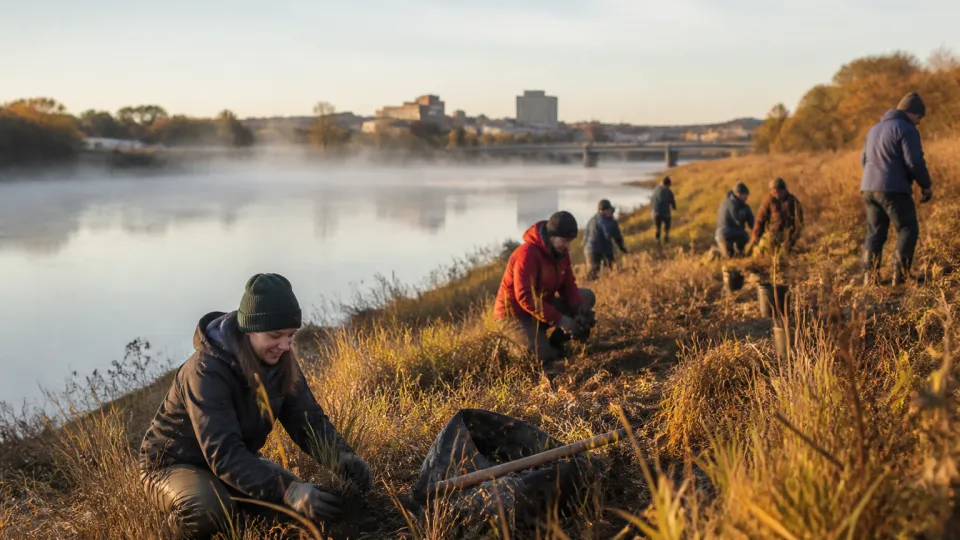
I stood on the Assiniboine's bank at first light and watched a thin mist lift from a channel that generations ago would have been wetlands. The river runs through Brandon with a casual confidence now — but beneath that surface are stories of dug drains, exposed soil, and an agricultural logic that once treated water as an inconvenience. Those long decisions shaped livelihoods, but they also left the landscape brittle.
The arc of Westman's environmental history is familiar across the Canadian Prairies: rapid settlement, aggressive wetland drainage, and an embrace of monoculture that delivered economic growth while erasing habitat. In the 1930s the Dust Bowl exposed the cost of that strategy. Farmers and communities learned hard lessons about soil, wind, and water. Yet, the decades that followed did not fully incorporate those lessons. It took climate volatility, new science, and a generation of local leaders to begin rethinking the trade-offs.
Today, change often arrives quietly, in actions that are as practical as they are symbolic. On a gently sloping field outside Rivers, a third-generation farmer, Anna Reimer, walks between strips of rye and clover she seeded last autumn. "We used to leave every field bare in fall because that's how my grandfather did it," she told me. "Now, when the snow melts I don't want to see a scoured field. Cover crops hold the soil. They keep moisture. It’s insurance for a family ." Her choice — a blend of tradition and — exemplifies the pragmatic pivot spreading through Westman.
Closer to the city, a patchwork of volunteers organizes the Riverbank Stewardship Collective. They plant native grasses, remove invasive species, and map floodplain corridors where water can be welcomed rather than expelled. "We wanted to stop treating the Assiniboine like a problem to be solved and start treating it like a neighbour," said Maya Sinclair, a biology student who coordinates monthly restoration days. The language is revealing: neighbours tend to each other, negotiate space, and absorb shocks together.
These grassroots efforts sit alongside municipal and regional initiatives to integrate green infrastructure. Stormwater projects that mimic natural wetlands reduce downstream pressure, improve water quality, and provide habitat for migratory birds. Small towns across Westman are experimenting with bioswales along Main Street and municipal incentives for riparian buffers. The results are incremental but measurable: calmer spring flows, clearer creeks, and a surprising return of songbirds to places once silent.
There is also a reawakening of Indigenous knowledge. Brandon and surrounding areas lie on Treaty 2 territory, and Indigenous elders and land keepers have emphasized seasonal observation and respect for water for generations. Partnerships that invite that knowledge into project design — from wetland restoration to controlled grazing strategies — have yielded solutions attuned to the prairie’s rhythms. "It’s not just science," an elder I spoke with said. "It’s remembering how the land taught us to live with water, not against it." That remembrance reshapes practice.
The economic realities that underlie these shifts deserve attention. Farmers contend with narrow margins, volatile markets, and unpredictable weather. Transitioning to regenerative practices often requires upfront investment and patience for long-term gains. Here, the has begun to experiment with shared risk strategies: cooperative equipment pools, local grants for seeding perennial cover, and pilot payment-for-ecosystem-services programs that compensate landholders for carbon storage and flood mitigation. These are small experiments, but they recalibrate who pays for resilience and who benefits.
If there is a single, modern imperative, it is to treat resilience as relational — not merely the outcome of or policy, but the product of everyday choices by neighbors, farmers, students, and municipal staff. Climate projections make the stakes clear: more extreme precipitation events, longer dry spells, and heightened stress on water systems. But resilience in Westman is not only response; it is design. It is creating landscapes that can soak up a spring surge, hold moisture through a dry summer, invite pollinators back, and sustain viable farms.
The work will be messy. Restoration often uncovers previously hidden tensions between conservation goals and working landscapes. Yet those tensions are also the source of creativity. When a high school class installs a beaver-friendly culvert and a farmer notices improved soil moisture downstream, the technical fix graduates into shared civic pride.
Standing again on the riverbank, I thought about those multi-generational conversations — between past practice and new science, between settler and Indigenous perspectives, between the economic pressures of production and the patient work of restoration. The Assiniboine does not return to a mythical past; instead, it asks Westman to invent a future where water, soil, and community are negotiated in public and practical ways. That reinvention feels, in the end, distinctly local and profoundly hopeful: a slow choreography of repair that could teach other prairie places how to be both productive and whole.