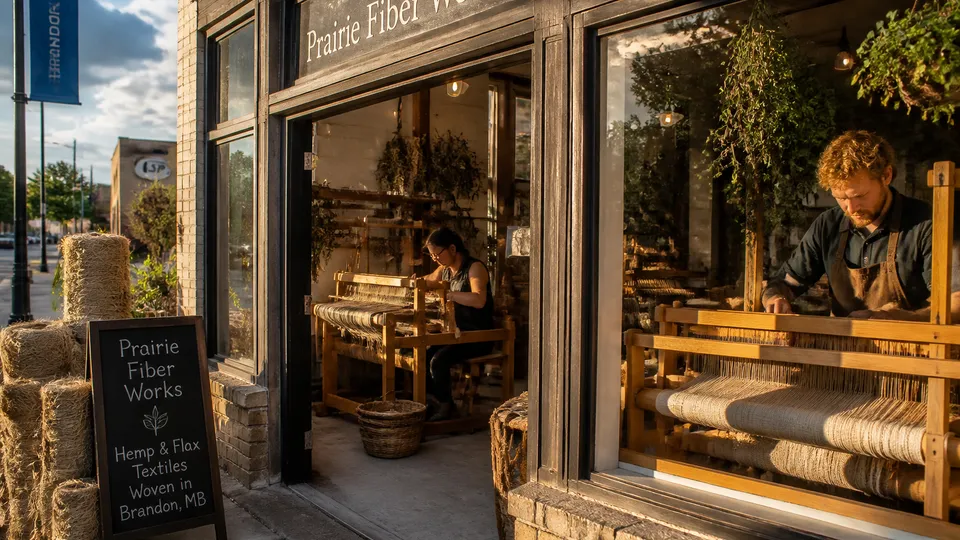
On a cold March morning the storefront windows on one of Brandon's quieter streets fog with breath and movement. Inside, a dozen people move between wooden looms and a humming decorticator, the machine that teases fiber from the stalks of hemp and flax. Sunlight slices in across bales of dried stalks stacked by the door, and the air carries a faint, green scent—something like hay and sea kelp at once.
This is Harvest & Loom Collective, a small social enterprise that has quietly reoriented a slice of Brandon's economy toward a different kind of prairie product: textiles grown, processed and woven within a 100-kilometre radius. What started two years ago as an experiment in upcycling agricultural residue has become, for many in Brandon, an improbable engine of local work, training and creative exchange.
"The idea came when I watched fields get burned in the fall," says Maya Larson, the founder, standing amid samples of hand-dyed scarves and woven upholstery. "There was this sense that there’s material here we throw away, and people here who need work. If we could put those two things together—carefully, respectfully—we might make something that mattered in both ways."
Larson grew up in the Westman region and left for design school in Winnipeg. She returned with a small grant and a conviction that sustainable manufacturing didn't have to be offshore or anonymous. Harvest & Loom sources stalks from a handful of nearby farms—flax grown for seed and hemp grown for grain—which would otherwise be baled and burned or tilled in. The collective's first technical challenge was practical: turning coarse, woody stalks into supple fiber without an industrial footprint.
To solve it they adapted a decortication process on a scale that fits a small workshop, combining a refurbished farm machine with a belt of shared labour and a low-water, plant-based dyeing system. The result is a range of hemp-flax textiles—blankets, outerwear panels, upholstery cloth—whose character is shaped by the prairie itself: muted tans and greens, flecks of straw, a texture that reads both durable and domestic.
The human architecture of Harvest & Loom is as important as its machines. About two dozen people pass through the collective each month—seasonal workers, apprentices, newcomers to the region seeking stable hours, and Indigenous artisans who have brought ancestral techniques to the project. "I learned how to spin here, but I taught them patterns my grandmother used," says an apprentice, who came to Brandon last year and now leads dyeing nights. "We’re exchanging skills, and the work feels like it has meaning beyond a paycheque."
Partnerships have kept the venture anchored. Brandon University design students collaborate on product development; a municipal grant helped retrofit the storefront; local farmers provide raw material at cost or for trade. But perhaps the most visible civic benefit has been the storefront itself. The collective's shop-front replaced a vacant unit in a block of small retailers and now hosts open-weave demonstrations, mending clinics and weekly evenings where people bring worn garments to repair or to learn simple weaving techniques.
Those programs matter because they reshape how a community thinks about material value. "People are shocked when they learn their scarf came from stalks grown on a farm down the road," says Larson. "There’s a reconnection—between consumer and source, between downtown and hinterland—that isn't just sentimental. It supports new economic flows." For a region shaped by agriculture and cyclic downturns, that matters.
The enterprise has also become an informal training ground. Harvest & Loom partners with an adult education centre to offer a short certification in fiber processing and small-batch textile production. Trainees leave with a mix of hard skills—operating the decorticator, warp and weft setup—and soft skills: inventory management, customer relations, basic bookkeeping. Several participants have gone on to start home-based craft businesses, while others have moved into more stable positions in town.
Of course, scaling a craft-centered model creates tensions. Larson is candid about the trade-offs: increasing production risks losing the hand-made qualities that distinguish their goods; expanding the machine shop requires capital that could shift priorities. "We keep asking ourselves how to grow without becoming the thing we were resisting," she says. "Our strategy is layered: we’re experimenting in small pilots, investing in people, and documenting processes so other communities can replicate the model without losing context."
Forward thinking at Harvest & Loom is pragmatic. The collective is piloting a regional supply network with three neighbouring municipalities, exploring low-energy retting techniques and testing a take-back program for damaged textiles so fibers can be reintegrated into new products. The collective's leaders imagine a future in which circular textile hubs—each tied to local crops and craft traditions—create resilient employment across the prairie rather than concentrating work elsewhere.
What keeps people coming back is not only wages but a sense of belonging. "You meet neighbors you never knew," says a volunteer who helps run evening mending clinics. "You sit with someone and fix a seam and hear their story. That’s part of what this place gives Brandon." That intimacy, stitched into every scarf and chair-cover, is the real : a form of economic development that is social, place-based and materially honest.
Outside, the winter light slants low across the Assiniboine, a long ribbon through the city. Inside Harvest & Loom, a new apprentice catches the rhythm of the loom, and the collective's storefront sign creaks slightly in a cold breeze. For a small city that has often watched industries ebb and flow, this is an experiment in making something new from the residue of what was already here—an example not of overnight reinvention but of gradual remaking, one careful stitch at a time.